First Concert in the Czech Republic
Yasukazu Kanó
Japanese Culture at Miyabi
Yasukazu Kanó
Yasukazu Kanó is a Japanese musician, composer, educator, and one of today’s leading performers of the traditional Japanese bamboo flute, the shinobue.
He was born in Tokyo in 1963. He began his musical journey at the age of thirteen, when he started playing percussion instruments. His first public performances took place while he was studying at the prestigious Hitotsubashi University. He later went to New York to continue his studies, where exposure to other cultures led him to develop a deeper awareness of his own Japanese roots. After returning to Japan, he decided to devote himself fully to music.
In 1987, he joined the world-renowned Japanese taiko drumming ensemble Kodō. During his time with the group, he took part in more than one thousand performances in twenty countries around the world, including an appearance at Carnegie Hall in New York.
After leaving Kodō in 1997, he began his career as an independent artist. While living on Sado Island, he focused primarily on the traditional bamboo flute, the shinobue. He explored its tonal and expressive possibilities and gradually developed his own performance and teaching technique, now known as the Shinobue KANO Method.
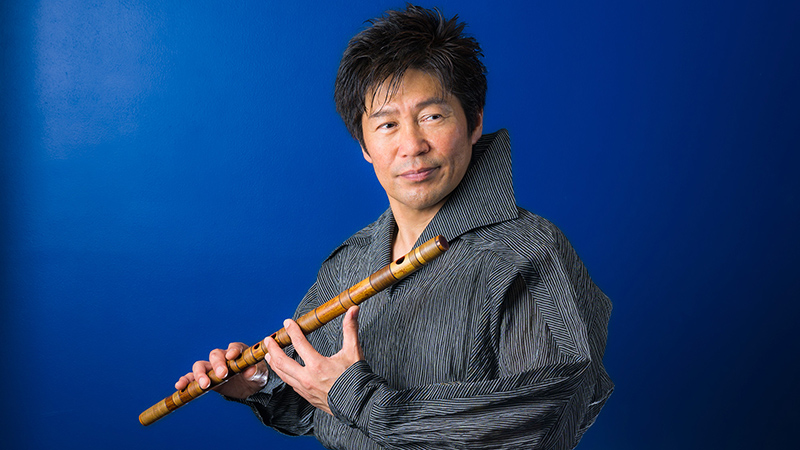
In 2005, he made his debut as a solo artist with Yamaha. Since then, he has released numerous music albums, instructional DVDs, sheet music publications, and photographic essays. Over the course of his career, he has performed more than two thousand concerts in thirty countries around the world.
Alongside his concert activities, he also works as a composer and music producer. He has written music for television programmes, films, and theatre productions, and among other projects composed the opening theme for an NHK programme dedicated to traditional Japanese arts.
Yasukazu Kanó regularly gives shinobue lessons and workshops both in Japan and abroad. Through his teaching programme and online videos, he works to preserve and further develop the tradition of this unique Japanese flute. His aim is not only to pass on traditional playing techniques, but also to bring the shinobue into new musical genres and encourage the creation of new music and culture.
He has performed at major events such as Expo Milano 2015 and has collaborated with a number of distinguished artists and performers. At the Tokyo Dome, he accompanied world karate champion Rika Usami, and he has also performed with artists including Kōsetsu Minami, Salena Jones, Ryuichi Kawamura, and Kimiko Ito.
He is also a member of the musical project WA-OTO, which brings together vocals, piano, and the distinctive sound of the Japanese shinobue flute.
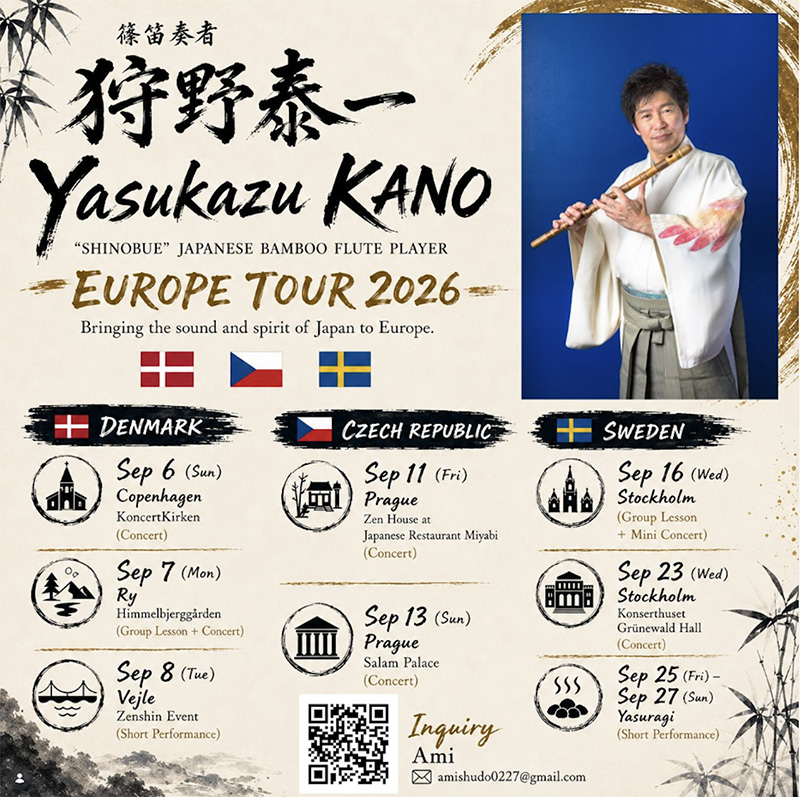
V roce 2026 se Yasukazu Kanó vydává na evropské turné, jehož součástí je také jeho vůbec první návštěva a vystoupení v České republice. Pražské publikum tak získá mimořádnou příležitost poznat z bezprostřední blízkosti nejen hudbu flétny shinobue, ale také osobnost umělce, který tradiční japonskou hudbu již několik desetiletí představuje posluchačům po celém světě.
What is the Shinobue?
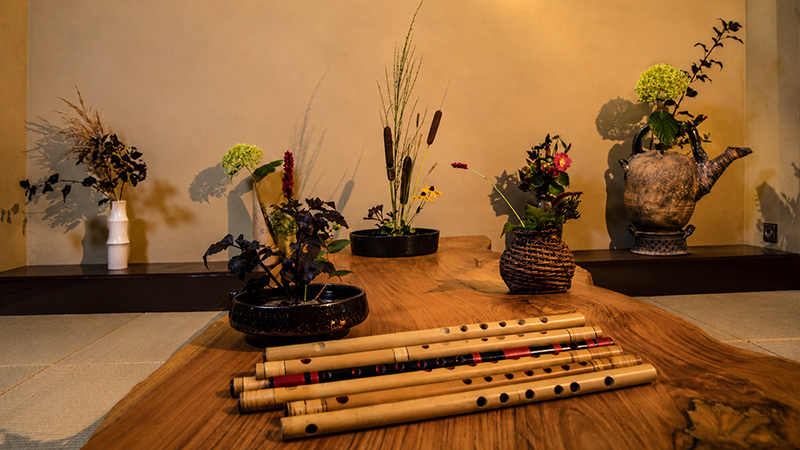
The shinobue is a traditional Japanese transverse flute made from a single piece of bamboo, with finger holes drilled into its surface. At first glance, it is a very simple instrument, yet its sound can be gentle, airy, and melancholic, as well as bright, joyful, and remarkably energetic.
The shinobue is regarded as one of the few musical instruments that originated and developed almost entirely within Japanese culture. Since ancient times, it has been an essential part of Japanese festivals, helping to preserve local traditions and strengthen bonds within communities. Its sound can be heard at matsuri festivals, in kagura ceremonial music, in kabuki theatre, and in traditional folk songs.
Today, however, the shinobue is no longer limited to traditional music. Alongside Japanese taiko drums and the stringed instrument shamisen, it can also be played with piano, guitar, and other modern instruments. It therefore finds a natural place in popular music, jazz, classical music, and contemporary cross-genre collaborations.
The expressive possibilities of the shinobue are closely connected to the player’s breath. As breath control and technique develop, an ever wider range of colours, moods, and emotions becomes possible, revealing just how expressive this seemingly simple bamboo instrument can be.